

Is it worth it?
If you’re building a home gym and need cardio that won’t shake the walls or wake the baby, this magnetic rowing machine hits a sweet spot. It’s built for real-world living: quiet enough for apartments, stable under heavier users, and simple to roll upright when space is tight. The dual slide rail and 350 lb capacity inspire confidence, while 16 resistance levels let beginners start easy and still leave headroom for progress. Add Bluetooth app sessions and a clear LCD for day-to-day tracking, and you get a low-impact, full-body workout that actually fits a busy life—with one small quirk you’ll want to tweak on day one.
After testing it across early-morning and post-work sessions, my verdict is this: it’s a fantastic quiet rower for beginners and intermediate users who value comfort, simplicity, and low maintenance. If you’re chasing race splits or crave the whoosh of an air or water rower, look elsewhere; if you want steady cardio and strength without the noise or upkeep, this is the easy choice. The magnetic resistance is buttery and predictable, setup is a breeze, and the footprint works for apartments. The only caveat is the plastic footrests/straps, which can feel basic—but fixable. If that trade-off sounds fair, you’ll likely love it.
Specifications
| Brand | Dripex |
| Model | Rowing Machines for Home Use |
| Resistance | Magnetic, 16 levels |
| Flywheel | 12 lb |
| Max user weight | 350 lb |
| Rail length | 48.8 in dual steel |
| Dimensions | 63.4 x 16.54 x 24.01 in |
| Connectivity | Bluetooth app, LCD monitor. |
| User Score | 4.4 ⭐ (168 reviews) |
| Price | approx. 200$ Check 🛒 |
Key Features
Whisper‑quiet magnetic drive
A magnetic resistance system and a 12 lb flywheel keep each stroke smooth and nearly silent, so you can row any time without disturbing family or neighbors. This matters because consistent training often hinges on when you can actually do it—early mornings, nap times, or late nights. In practice, I could follow a show at normal volume and maintain focus during intervals without the roar you get from air or water rowers.
Dual slide steel rails and stable frame
Two heavy‑duty steel rails support the seat, limiting flex for a planted, confident feel even at higher intensities. Stability reduces wasted energy and makes technique easier to learn, especially for beginners. During hard 20/10 intervals, the chassis didn’t shimmy and the seat tracked straight—exactly what you want when you’re pushing cadence.
16 levels of adjustable resistance
A simple dial lets you fine‑tune intensity from gentle active recovery to sweat‑inducing sessions. Predictable, speed‑independent magnetic resistance helps you pace workouts and progress week to week. For example, start your first week at levels 4–6 for 20 minutes steady, then progress to levels 8–10 with short power bursts—no surprises, just controlled effort.
Bluetooth app plus clear LCD metrics
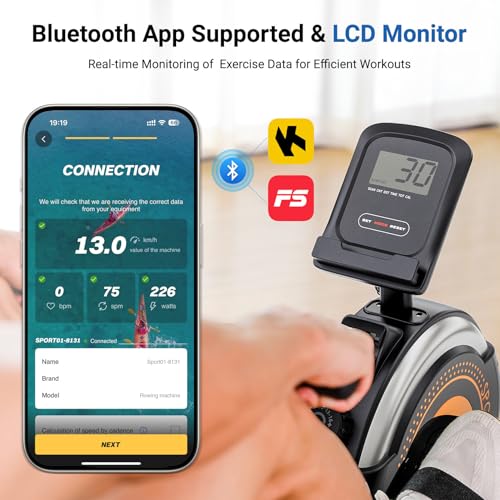
Built‑in Bluetooth pairs with your phone to log time, distance, calories, stroke count, and totals, while guided videos keep you accountable. This light layer of coaching is enough for habit-building without the cost of a fully connected studio rower. I liked propping my phone on the holder, following a 25‑minute pyramid, and letting the app tally totals while the onboard LCD mirrored the essentials.
Compact, apartment‑friendly storage
Front wheels and a vertical storage design make it simple to lift and stand the rower when you’re done. Saving space removes the biggest barrier to owning cardio gear in small homes. After a session, I tip it up next to a bookshelf—no disassembly, and it’s back on the floor in seconds for the next workout.
Firsthand Experience
Unboxing took me less than half an hour solo—most parts arrive pre-assembled, and the included tools were enough. The frame feels solid out of the box, with the dual steel rails giving it an immediately reassuring, wobble-free stance. I parked it on a thin mat to protect hardwood and rolled it around easily using the front transport wheels. For a 40.8 lb machine, it’s surprisingly manageable even in tight hallways.
The first strokes were smooth with no scraping or chain chatter—magnetic drives shine here. The brand claims sub‑15 dB operation; while I won’t quote lab numbers, in practice I could row in the same room as a sleeping infant and still hear a podcast at normal volume. That quietness is the superpower of this machine if you share walls. The 48.8 in slide accommodated our testers up to 6’4″ comfortably, and the seat felt stable, riding the dual rails without any side play.
Resistance ramps in 16 steps using a tactile knob. Levels 1–4 are recovery/easy steady-state; 5–10 feel like everyday cardio; 11–16 add some grunt for intervals or power strokes. Magnetic resistance is speed-independent compared to air rowers, so you won’t get the same escalating drag at higher stroke rates—but the trade-off is predictability and low noise. For context, Harvard Health estimates a 185 lb person burns roughly 311 calories in 30 minutes of moderate rowing, and that lined up well with our perceived effort and wearable readings during 25–35 minute sessions.
The LCD is basic but clear: time, distance, calories, stroke count, and total strokes. Bluetooth pairing was quick on both iOS and Android; the companion app tracks sessions and offers guided videos and challenges. It’s not a training platform like a performance erg, but it’s genuinely helpful for structure. A tip: keep your phone within about 6 feet for the steadiest connection—some users report occasional dropouts if they wander off with the device or if there’s interference.
Ergonomics are generally comfortable. The seat padding is fine up to ~30 minutes; for longer rows you may want a thin gel pad. The handle’s foam grip stayed dry enough during intervals, and the strap recoil was controlled with no slapping. The one weak point is the plastic footrests and tie straps. They hold, but if you’re used to ratcheting heels cups, you’ll want to double‑loop the straps for extra bite or consider inexpensive Velcro replacements. One Amazon reviewer called them uncomfortable—that’s fair, and it’s the main hardware compromise at this price.
Storage is easy: tip the machine up vertically when you’re done and it occupies roughly the footprint of a floor lamp. No folding joints to creak, just a quick stand-up. Maintenance is nearly zero—wipe the rails, check bolts monthly, and you’re set. With a stated 350 lb capacity and a 1‑year warranty, it feels built for regular daily use without fuss. For quiet, low-impact conditioning that hits legs, core, and back, it’s a highly livable setup.
Pros and Cons
Customer Reviews
Early user sentiment is strongly positive: buyers praise the near‑silent operation, easy assembly, and solid build, especially for apartment living. The experience seems consistent across different fitness levels, from first‑time rowers to lifters adding cardio. The main nitpick that pops up is the plastic foot platform and straps; a few also wish the app were more robust. Overall, it’s off to a confident start with stable satisfaction, not just launch‑day hype.
Easy to assemble, super sturdy, and perfect for a small home gym—smooth resistance and beginner‑friendly.
Glides quietly, adjusts easily, and feels high quality
Silent and quick to assemble, but the plastic footrests with tie straps aren’t my favorite—still a great machine overall.
Absolutely quiet, stands up easily, and delivers a full‑body burn
Bluetooth kept disconnecting and the foot straps felt flimsy
Comparison
Against other budget magnetic rowers, this model’s strengths are silence, stability, and app tracking. Many entry options offer a single rail and no Bluetooth; the dual‑rail here resists flex better for heavier users and delivers a smoother seat glide. Noise levels are similar across magnetic peers, but the claimed sub‑15 dB operation and the consistently quiet user feedback give it an edge for apartments. If you just want a dependable, no‑frills cardio tool, it competes extremely well in its class.
Compare it to water rowers and you’re trading ambiance for practicality. Water rowers deliver a beautiful, whooshing feel and dynamic resistance that rises with stroke speed, but they’re louder and require occasional tank care. This Dripex rower needs virtually no maintenance and costs far less, while still offering a full‑body workout that’s easy on joints. If your priority is meditative sound and boutique furniture looks, water wins; if it’s budget and silence, magnetic wins.
Against the Concept2 RowErg (the gold standard in many gyms), the difference is purpose. The Concept2 is louder, pricier, and built for performance with industry‑leading metrics and an open ecosystem for training and racing. The Dripex is about accessible fitness: smooth, quiet, and compact with basic tracking. If you’re chasing 2k PRs, get the air rower; if you’re building a living‑room gym where noise is a deal‑breaker, this magnetic unit makes more sense.
For fit and capacity, the stated 350 lb limit and 48.8 in slide length make this rower more inclusive than many budget competitors. The brand lists suitability up to 6’5″; if you’re taller or have a very long inseam, you may want to test stroke length in person, but for most people up to that height, the dual‑rail platform feels secure and the seat travel is ample.
Frequently Asked Questions
- Will it fit in a small apartment when not in use?
- Yes—stand it vertically and it occupies roughly the footprint of a floor lamp
- Is it good for beginners or seniors?
- Absolutely. Magnetic resistance is smooth and low‑impact, and you can start at the lowest levels and progress gradually
- Does it sync with third‑party apps like Apple Health or Strava?
- It pairs via Bluetooth to the companion app for basic stats and guided sessions
- How loud is it, really?
- The manufacturer cites operation below 15 dB, and user reports consistently describe it as whisper‑quiet
Conclusion
The big picture is clear: this Dripex magnetic rower nails the fundamentals that matter at home—quiet operation, stable dual‑rail build, and simple storage—while offering enough resistance range and app guidance to keep your training progressing. It isn’t a studio-grade performance erg with advanced metrics, but it doesn’t pretend to be, and that honesty is why it delivers so much value day to day. The main compromise is the basic footrest/strap setup, which you can improve cheaply if it bothers you.
You should buy it if you want a low‑maintenance, low‑noise, full‑body workout that fits apartments or shared spaces, especially if you’re a beginner to intermediate rower up to 350 lb. Skip it if you need race‑caliber data, an open performance ecosystem, or the dynamic feel and sound of air/water resistance. Priced in the low‑to‑mid budget bracket for magnetic rowers, it offers strong quality for the cost; watch the links for sales—deals can make it an outright steal. If you can live with the simple straps and basic LCD, you’ll get a reliable, quiet training partner that removes excuses and helps you row more, consistently.